Tamarindo and Guanacaste: Transfer Fares, Park Fees and the Rain Calendar
Verified on 26 August 2026, on SINAC’s own park pages, the national meteorological institute’s climate baseline for the region, the airport authority’s own pages and each operator’s own rate page.
Liberia’s Guanacaste Airport (LIR) to Tamarindo takes 1.5 hours, at USD 30 per person on a shared shuttle or USD 85 for a private transfer, the same in both directions. Tamarindo bay sits inside Parque Nacional Marino Las Baulas, open every day 6:00 a.m. to 6:00 p.m. — and SINAC’s own park page states plainly that there is no turtle observation at present; the estuary visit is with local guides and needs no reservation. Group surf lessons in Tamarindo start at USD 60 per person for 90 minutes.
The national park at the end of Tamarindo beach was created for the leatherback turtle, and SINAC’s own page says it is not currently offering turtle observation; the only entrance fee ever published for it sits in a document that prints no date, was created in December 2018, and is demonstrably out of date on other parks’ hours.
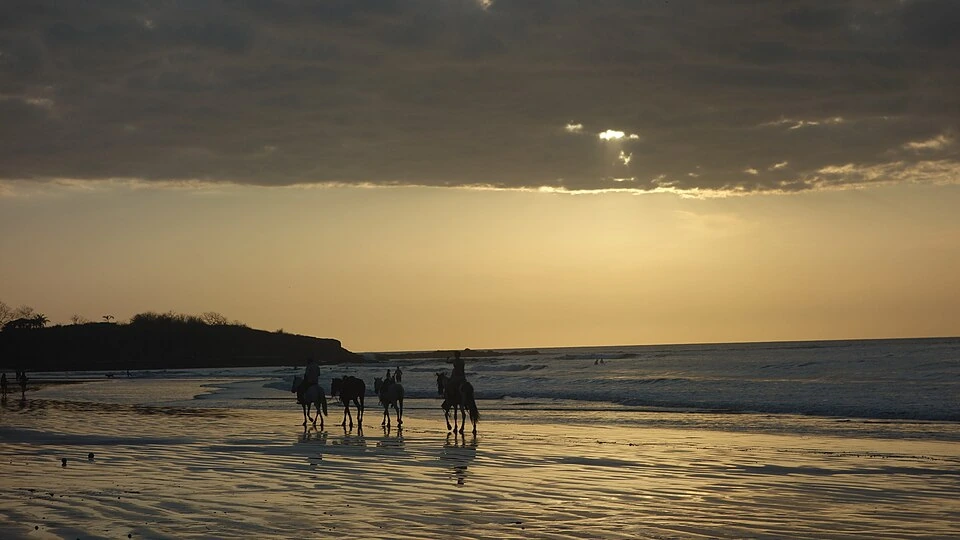
Getting from Liberia airport
Tamarindo Transfers & Tours publishes fares and drive times for every destination it serves out of LIR. These are the operator’s own figures, not a road authority’s, and the operator publishes no kilometre distances at all. How those transfer prices compare with driving yourself is on our rental car versus shuttle page.
| From LIR to | Private transfer | Drive time |
|---|---|---|
| Tamarindo | USD 85 (or USD 30 per person shared) | 1.5 h |
| Secrets Papagayo | USD 75 | 45 min |
| Playa Grande | USD 85 | 1.5 h |
| Flamingo | USD 90 | 1.5 h |
| Potrero | USD 90 | 1.5 h |
| Las Catalinas | USD 95 | 1.5 h |
| W Resort Conchal | USD 95 | 1.5 h |
| Hacienda Pinilla | USD 95 | 1.5 h |
| Marbella | USD 95 | 2 h |
| Avellanas | USD 100 | 2 h |
| Nicoya | USD 100 | 2 h |
| Rincón de la Vieja | USD 110 | 1.5 h |
| Nosara | USD 140 | 2.5 h |
| Monteverde | USD 160 | 3 h |
| Arenal Volcano | USD 180 | 3 h |
| Santa Teresa / Montezuma | USD 200 | 4 h |
| Jaco | USD 240 | 4 h |
| Manuel Antonio | USD 280 | 5 h |
Checked 26 August 2026. The same operator prices SJO (San José) to Tamarindo at USD 220 private, 4 to 5 hours, in either direction. Three other companies publish the Liberia–Tamarindo leg: Tropical Tours Shuttles at USD 30 shared and USD 100 private, Easy Ride at USD 39 shared, and LIR Shuttle from USD 89 private. Those fares and the taxi regulator’s own per-kilometre tariff sit side by side on our Liberia airport to Tamarindo page.
Where the private transfer beats the shared shuttle to Tamarindo. Tamarindo is the one destination on this list with both a shared and a private rate published, so it is the only one where the arithmetic can be done. At USD 30 per person against USD 85 flat:
| Passengers | Shared | Private | Cheaper |
|---|---|---|---|
| 1 | USD 30 | USD 85 | Shared, by USD 55 |
| 2 | USD 60 | USD 85 | Shared, by USD 25 |
| 3 | USD 90 | USD 85 | Private, by USD 5 |
| 4 | USD 120 | USD 85 | Private, by USD 35 |
| 5 | USD 150 | USD 85 | Private, by USD 65 |
| 6 | USD 180 | USD 85 | Private, by USD 95 |
It flips at three, and it flips by only USD 5 there. Keep this figure to this destination rather than carrying it to the others — the operator publishes no shared fare for any of them.
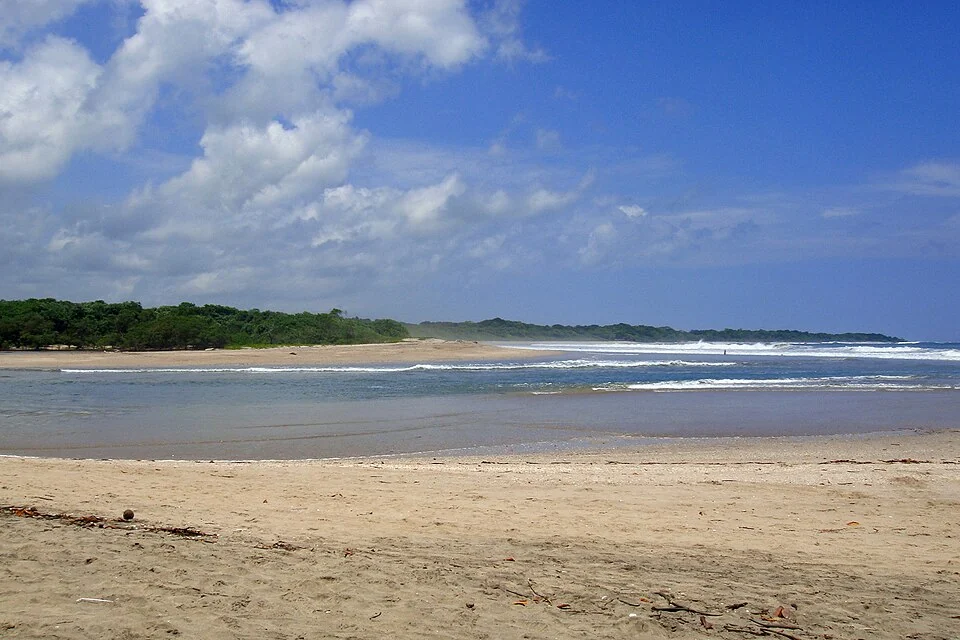
Parque Nacional Marino Las Baulas
| Hours | Every day of the year, 6:00 a.m.–6:00 p.m. |
| Nesting season | October–February; visitors may stay on the beach only until 5:00 p.m. |
| Turtle observation | Not currently offered, per SINAC |
| Estuary visit | With local guides; no reservation needed |
| Beach carrying capacity | 120 people, 60 at each of two entrances |
| Non-resident entrance fee | USD 12 before IVA — about USD 13.56 with it — see the caveat below |
The park authority’s own page states it verbatim: “No hay observación de tortugas y la visita al estero es a través de guías locales. No es necesario reservar.” Turtle observation excluded; the estuary visit is with local guides; walk-ins accepted.
The fee is the weakest number on this page and we are labelling it as such. USD 12 for non-residents and CRC 1,600 for nationals and residents appears only in SINAC’s consolidated tariff PDF. That document prints no date on its face, but its file metadata records a creation date of 21 December 2018 — we read the file’s own metadata on 26 August 2026 — and it still lists Volcán Turrialba as “totalmente cerrado” for the 2014–2015 eruptions. (It also prices Rincón de la Vieja at USD 15 against that park page’s USD 16.95 — but that one is not evidence of staleness: 15 × 1.13 = 16.95, so it is the same fee quoted before and after IVA.) Las Baulas is not sold through SINAC’s online booking system, so there was no live price to cross-check it against. Treat USD 12 as the last figure SINAC published, not as a confirmed current rate. The same PDF puts non-resident children aged 2 to under 12 at USD 5 and resident children at CRC 500.
And USD 12 is not what you would hand over. That PDF is a schedule of pre-IVA decree tariffs — the Rincón row above proves it, where the PDF’s USD 15 is the live park page’s USD 16.95 with 13% added. Costa Rican park fees carry that 13% on top of the headline figure, so on the PDF’s own basis a non-resident adult at Las Baulas pays about USD 13.56 and a child aged 2 to under 12 about USD 5.65. Those two gross-ups are our arithmetic at the same 13% rate SINAC applies on its own tax-inclusive park pages; the USD 12 and USD 5 are SINAC’s. We could not establish the tax treatment of the colón resident rates — SINAC’s Rincón page publishes resident fees VAT-included while its Manuel Antonio page publishes CRC 1,600 with no tax note either way, and Las Baulas has no live page to settle it.
The park itself is given by SINAC as 175 km², made up of 7.7 km² on land and 171.36 km² of sea out to 12 nautical miles. Those two components sum to 179.06 km², not 175 — SINAC’s own stated total and its own breakdown do not agree, and we are printing both rather than adjusting either to close the gap. It lies in the canton of Santa Cruz, districts of Cabo Velas and Tamarindo. The two official entrances are caseta #1 at the MINAE offices and caseta #2 at the edge of the Tamarindo estuary. SINAC records 117 tree and shrub species and 139 bird species in the park, 55 of them latitudinal migrants, and lists the Tamarindo estuary as a wetland of global importance.
It was created for the leatherback (Dermochelys coriacea), which SINAC describes as critically endangered worldwide; the olive ridley (Lepidochelys olivacea) and the black or green turtle (Chelonia agassizii) also nest there, on Playa Grande, Playa Ventanas and Playa Langosta, October to February.
Playa Grande and Playa Langosta are inside the park, and SINAC names both as surf beaches; it names Playa Carbón for snorkelling. Both are absent from the ten Costa Rican beaches the U.S. State Department lists as having lifeguard presence — Tamarindo itself is, and what that list says, with its own caveat about rip currents, is set out separately. Park rules ban dogs, alcohol, smoking, single-use plastics, vehicles on the beach, horseback rides, campfires and loud music.
Parque Nacional Rincón de la Vieja
The province’s other national park is priced and sold quite differently from Las Baulas.
| Non-resident adult | USD 16.95, VAT included |
| Non-resident child | USD 5.65 |
| National / resident adult | CRC 1,130 (child CRC 565) |
| Over 65 with cédula | Free |
| Las Pailas sector | Tuesday–Sunday, 8:00 a.m.–3:00 p.m.; closed Monday |
| Santa María sector | Thursday–Monday, 8:00 a.m.–3:30 p.m.; closed Tuesday and Wednesday |
| Sold | Online only, through SINAC’s purchase and reservation system |
The two SINAC fee figures for this park are not a conflict, and we are correcting an earlier reading of ours that treated them as one. The park page says USD 16.95 VAT included; the consolidated tariff PDF, whose file metadata dates it to 21 December 2018, says USD 15. USD 15 × 1.13 = USD 16.95 exactly — SINAC publishes the same fee on some pages before tax and on others with tax, and these are the two halves of one number, not two prices. You pay USD 16.95. There is a real conflict on the hours: the park page gives Las Pailas as Tuesday to Sunday 8:00 a.m.–3:00 p.m.; the same 2018 PDF gives both “every day, 8:00 a.m. to 4:00 p.m.” for Pailas and “de martes a domingo de 7 am a 3 pm” elsewhere in the same document. We are printing both sides and not averaging.
The park was created by Law No. 5398 of 23 October 1973 and covers 14,300 hectares. The massif is made up of nine craters, and 32 rivers rise there.
Trails, from SINAC’s own page: the Sendero Circular Las Pailas is 3 km, about two hours, past fumaroles and mud pots at 78 to 106 °C. La Cangreja waterfall is 5 km each way — 10 km round trip — and Catarata Escondida 4.3 km each way, both 4 to 5 hours round trip, and swimming is not allowed at either. Waterfall-trail entry is allowed 8:00 a.m. to noon in the dry season, December to April, and access may be regulated in the rainy season. The Active Crater trail, 8 km each way, is closed because of volcanic activity.
When it rains in Guanacaste
Guanacaste falls in the Instituto Meteorológico Nacional’s Pacífico Norte climate region, whose baseline climatology covers 1961–1990. The region’s rainfall is not evenly split across the wet half of the year, and the pattern has a name.
| Period | Share of annual rainfall |
|---|---|
| December–March (dry season) | 4% |
| April | transition month; rains establish around the third ten-day period of May |
| May–August | 50%, with the first rainfall maximum in June |
| July–August | the veranillo or canícula — a mid-summer dry spell inside the wet season |
| September–November | 46%, September and October the wettest |
| November | transition back to the dry season |
Region-wide annual rainfall averages 1,500 to 2,500 mm, which IMN describes as making the Pacífico Norte one of the driest and hottest parts of Costa Rica, across 136 rain days a year on average. By sub-zone: the Guanacaste and Tilarán mountain ranges take close to 2,200 mm a year at 25 °C by day and 17 °C at night; the peninsular zone, which includes the Nicoya peninsula, close to 1,900 mm with daytime maxima averaging 33 °C and nights around 22 °C; the Tempisque depression is the driest at about 1,700 mm and the hottest at 32 °C by day.
For Tamarindo bay specifically, SINAC records annual precipitation inside Las Baulas at 1,811.2 mm, with 95% falling between May and November and 4.2% between December and April — the most locally specific rainfall figure available from a Costa Rican government source.
El Niño years are materially drier. IMN puts an extreme dry event at 417 mm below normal — a 26% annual deficit — with up to 24 fewer rain days and daytime temperatures about 1.2 °C higher. An extreme wet event adds 544 mm (28%) and lowers temperatures 1.2 to 1.6 °C. 79% of extreme dry events are associated with El Niño; La Niña carries a 60% probability of producing a wet scenario.
Surfing in Tamarindo
Iguana Surf, operating since 1989, prices a 90-minute group lesson at USD 60 per person, with a maximum of four students per instructor; semi-private is USD 80 and private USD 100, all plus tax. Every lesson includes a soft-top board, rash guard, shower and changing facilities, a locker, a bilingual ISA-certified instructor and a surf theory and safety briefing. Arrive 15 minutes early. Surfers of 12 and under need their own dedicated instructor, at a small add-on. Lesson guests get 50% off board rentals for the rest of their stay.
Multi-day packages, plus tax, include photos, a T-shirt and unlimited board rentals: 3-day from USD 350 (semi-private USD 350, private USD 390), 6-day from USD 610 (USD 610 / USD 670), 7-day from USD 670 (USD 670 / USD 750). Iguana Surf summarises its own range as USD 350 for the 3-day to USD 752 for the 7-day private — two dollars above the USD 750 the same page prints for that package.
Its rental fleet runs to over 125 boards, from 5'6" fishes to 10'0" longboards, all epoxy or soft-top.
Witch’s Rock Surf Camp sells something different and should not be compared line-for-line with a lesson price: an off-site surf program at USD 200 per person per day, or USD 1,400 for a 7-day week, covering daily instruction, video coaching sessions and equipment. That is a day-rate coaching program, not a single lesson. Whether it bundles a bed is not published; the town’s own room rates, US$66 to US$488 a night as priced on 26 August 2026, are on our where to stay in Tamarindo page.
The airport itself
Liberia’s airport is officially Daniel Oduber Quirós International Airport, trading commercially since 2021 as Guanacaste Airport (IATA: LIR). It reports 2025 as a record year at 1,973,831 passengers, tripling traffic since the terminal opened, and lists 23 international destinations on its own destinations page: 16 in the United States (Charlotte, Dallas, New York, Miami, Chicago, Philadelphia, Los Angeles, Seattle, San Francisco, Boston, Atlanta, Minneapolis, Denver, Houston, Baltimore, Newark), six in Canada (Montreal, Toronto, Calgary, Ottawa, Vancouver, Winnipeg) and one in Europe (Zurich).
The airport’s own pages give two airline counts that do not match: its history timeline says 12 airlines on 26 direct international routes in 2025, while its live airlines directory lists 14 carrier entries, among them Air Canada, Air Transat, Alaska, Delta, Discover, Edelweiss, JetBlue, Porter, SANSA, Southwest, Sun Country, United and WestJet. One is a 2025 statistic and the other a current directory; we are printing both rather than choosing.
For context on the terminal itself: it was inaugurated in 2012 serving 14 routes and 14 airlines, expanded in 2018 at a cost of USD 10.3 million, and passed 10 million cumulative passengers in 2022.
What the operators don’t publish
These are gaps in what the operators and authorities publish, not in our search:
- Any kilometre distance from Liberia airport to Tamarindo, or between Tamarindo and Playa Grande, Flamingo, Conchal, Avellanas or Nosara. The airport, SINAC and MOPT all publish none, and MOPT’s road-section database throws a server-side error on route search. Operators publish drive times only.
- A dated, current SINAC source for the Las Baulas entrance fee. The only SINAC document carrying a price is the consolidated PDF, whose file metadata dates it to December 2018, and Las Baulas is absent from SINAC’s online ticketing system.
- The price of the Las Baulas guided estuary or mangrove tour. SINAC lists the service and no fee.
- Daily surfboard rental rates in Tamarindo. Iguana Surf’s rates sit inside a TuriTop booking widget that does not render server-side, so its fleet is documented and its rental prices are not.
- A shared Interbus seat on this pair. This is a gap in Interbus’s product, not in what it publishes: queried for 15 October 2026, its booking engine returned a single private row — "(PRIVATE) LIBERIA - TAMARINDO PRIVATE SERVICE 9 PAX $161.00" — and no shared row at all. That is a fact about one operator and not about the road: two other companies do sell a shared seat on it, and their fares are above and on our Liberia airport to Tamarindo page.
⚠ Three entries that stood here on 26 August 2026 have been withdrawn, because the cohort refutes them. This page had listed Interbus, Easy Ride and Tropical Tours fares for this corridor as unavailable. They are all published: Tropical Tours Shuttles at USD 30 shared and USD 100 private, re-read in that page’s raw HTML on 27 August 2026; Easy Ride at USD 39, three departures, about 1.5 hours, from its own Liberia-airport page; and Interbus’s private figure above from its own booking engine. The original notes recorded a reservation system under maintenance, a redirect stub served to non-browser clients and a timetable page without prices — each of those was a fetch failing on one route, and none of them was a publisher declining to publish.
How we researched this
Scope: this page reports source research, not an on-site test. We checked the booking systems, timetables and official sources named below on the date shown; calculations, unresolved disagreements and information we could not verify are labelled explicitly.
On 26 August 2026 we read SINAC’s own park pages for Parque Nacional Marino Las Baulas and Parque Nacional Rincón de la Vieja, plus SINAC’s consolidated entrance-tariff PDF, from which the Las Baulas fee and the Rincón figures come; that PDF prints no date on its face, and we read its file metadata the same day, which records creation and modification on 21 December 2018. Hours, capacity, trail lengths, park rules and the “no turtle observation” statement come from the two park pages.
Climate figures come from the Instituto Meteorológico Nacional’s own regional climate document for the Pacífico Norte, read locally from the PDF; the Tamarindo-bay rainfall figure comes from SINAC’s Las Baulas page instead, because it is more local. Transfer fares and drive times come from Tamarindo Transfers & Tours’ own transfer pages, surf prices from Iguana Surf’s and Witch’s Rock’s own pages, and airport figures from Guanacaste Airport’s own about, destinations and airlines pages.
Where two sources disagree — the Rincón hours, the airline count — we print both. Where two SINAC figures turned out to be the same fee quoted with and without the 13% IVA, we say so and give the figure you actually pay rather than manufacturing a conflict. Where the only available figure is old, we say how old and what else in that document is out of date.
We deliberately did not publish the airport’s two headline claims about the share of the world’s biodiversity and of all marine life that Guanacaste holds. Those are the airport’s own marketing percentages, not a measurement by IMN or SINAC, so we do not reproduce the numbers, and nothing on this page depends on them.
Figures on this page labelled our arithmetic are calculated by us from the sourced inputs cited below — comparisons, percentages, multiples, differences, per-night and per-person conversions, running totals and currency conversions. Every other figure is reproduced as its named source published it. Where an operator or authority publishes a per-person or per-night rate directly, that is their figure and it is attributed to them at the point it appears.
Sources
- SINAC — Parque Nacional Marino Las Baulas — hours and the nesting-season 5 p.m. rule, the “no turtle observation” statement, the 120-person capacity and two casetas, park area, species counts, the 1,811.2 mm rainfall figure, the named beaches and the park rules.
- SINAC — Parque Nacional Rincón de la Vieja — the USD 16.95 / USD 5.65 fees and resident rates, sector hours, the online-only sale, the 1973 law, the 14,300 ha area, the nine craters and 32 rivers, and every trail length and closure.
- SINAC — Tarifas de ingreso a áreas silvestres protegidas (PDF, no date on its face; file metadata dated 21 December 2018) — the pre-IVA USD 12 Las Baulas adult and USD 5 child tariffs, the CRC 1,600 and CRC 500 resident rates, the pre-IVA USD 15 Rincón tariff, and the competing Rincón hours.
- SINAC — online purchase and reservation system — confirmation that Rincón de la Vieja is sold there and Las Baulas is not.
- IMN — El clima, su variabilidad y cambio climático en Costa Rica, Pacífico Norte — the seasonal rainfall shares, the veranillo, regional rainfall and temperature by sub-zone, 136 rain days, and the El Niño / La Niña figures.
- Tamarindo Transfers & Tours — Liberia Airport transfers — every transfer fare and drive time in the table, the USD 30 shared Tamarindo fare, and the SJO–Tamarindo USD 220.
- Tropical Tours Shuttles — Liberia to Tamarindo — its USD 30 shared and USD 100 private fares, re-read in the page’s raw HTML on 27 August 2026.
- Easy Ride — Liberia airport shared shuttle — its USD 39 shared fare, three departures and approximately 1.5-hour duration.
- LIR Shuttle — Liberia airport to Tamarindo — its “from USD 89” private fare.
- Iguana Surf — group surf lessons — the USD 60 / 80 / 100 lesson prices, the 90-minute duration, group size and what is included.
- Iguana Surf — Tamarindo surf lessons — the 3-, 6- and 7-day package prices and inclusions.
- Iguana Surf — surfboard rentals — the 125-board fleet and the 50% lesson-guest discount.
- Witch’s Rock Surf Camp — surf camp — the USD 200-a-day and USD 1,400-a-week program rates.
- Guanacaste Airport — About Us — the official airport name, the 2021 brand launch, the 1,973,831 passengers in 2025, the 26-routes/12-airlines line and the terminal timeline.
- Guanacaste Airport — Destinations — the 23 destinations by country.
- Guanacaste Airport — Airlines — the 14 carrier entries currently listed.
Last verified: 26 August 2026 — except the Tropical Tours Shuttles figures, re-read on 27 August 2026. Transfer fares, surf prices and park hours change without notice, and the Las Baulas entrance fee above is the last one SINAC published rather than a confirmed current rate.
Written by Estuardo Enriquez. This site is independent, carries no affiliate relationship with any operator named here, and is not connected to any previous owner of this domain.