Manuel Antonio and Quepos: Park Fees, Hours and the Tuesday Closure
Verified on 26 August 2026, on SINAC’s own Spanish and English park pages, its 2023 visitor brochure, and the national bus-fare register held by the regulator ARESEP.
Manuel Antonio National Park costs USD 18.08 for a non-resident adult and USD 5.65 for a non-resident child aged 2 to 12. It opens Wednesday to Monday, 7:00 a.m. to 3:00 p.m., and is closed every Tuesday. Tickets are sold online only, through serviciosenlinea.sinac.go.cr — there are no gate sales — and the ticket is valid once, against photo ID. SINAC publishes no current daily visitor cap for the park.
Every step at this park is booked in advance: it is booked, capped, single-use and ID-checked, which is the exact opposite of how Arenal Volcano National Park sells its tickets. The Tuesday closure is the fixed point to build a 10-day itinerary around.
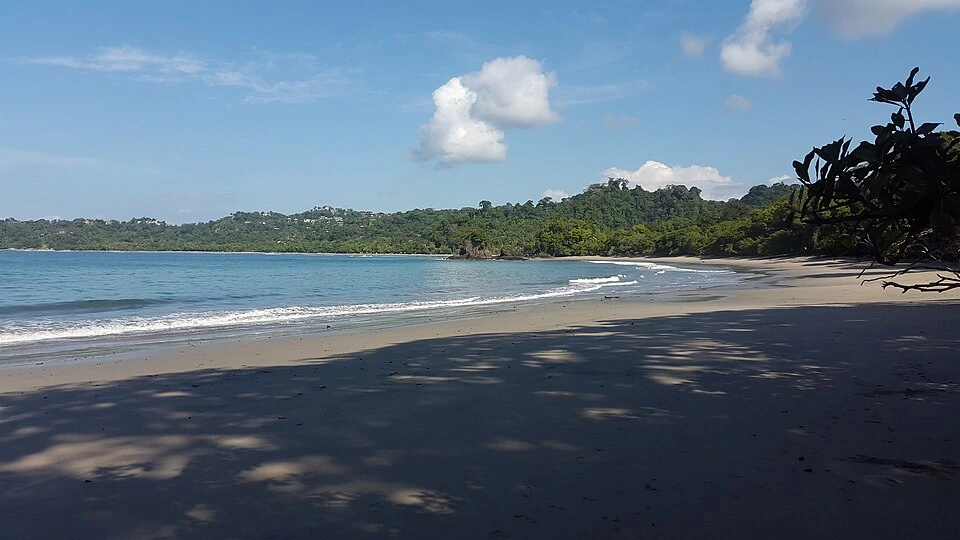
Fees and hours
| Non-resident adult, over 12 | USD 18.08 |
| Non-resident child, 2 to 12 | USD 5.65 |
| Hours | Wednesday–Monday, 7:00 a.m.–3:00 p.m. |
| Closed | Tuesdays |
| Daily capacity | not currently published — see below |
| Sold | Online only, at serviciosenlinea.sinac.go.cr |
Checked 26 August 2026 on SINAC’s park page. SINAC lists lower national and resident rates separately; those are only granted on showing a valid cédula, and without one the non-resident rate applies.
USD 16 and USD 18.08 are the same price
Both numbers appear in SINAC’s own sources. They are one price quoted with and without tax, not two competing prices.
SINAC’s English page for the park states the rate as “Adults (over 12 years old) $ 16 + IVA” and “Children (from 2 to 12 years old) $ 5 + IVA”. SINAC’s Spanish page shows $18,08 and $5,65. Costa Rica’s IVA is 13%: 16 × 1.13 = 18.08 and 5 × 1.13 = 5.65, which are exactly the figures the Spanish page prints. Both pages are SINAC’s own, and they corroborate each other.
You pay USD 18.08. Anything quoting a flat USD 16 is quoting the pre-tax decree tariff.
The Tuesday closure, and the two closing times
SINAC’s park page states the park is open “de miércoles a lunes en horario de 7:00 a.m. a 3:00 p.m. (martes cerrado)”.
Two conflicts sit underneath that, and we are printing both sides of each rather than tidying them away.
Closing time. Three SINAC-published sources give two answers: the live park page says 3:00 p.m.; the ICT/SINAC visitor brochure (Version 2023) says 16:00; the consolidated tariff schedule — no date on its face, file metadata December 2018 — says “de 7 am a 4 pm”. The park page is the maintained one. Plan around 3:00 p.m. and know that the printed brochures still say 4.
Closed day. The park page and the 2023 brochure both give a flat Tuesday closure, year-round. The undated tariff schedule instead describes a seasonal pattern — closed Mondays in low season, July to November, open every day in high season, December to April. That document also still lists Volcán Turrialba as closed for the 2014–2015 eruptions, so it carries visible age.
Buying a ticket — online only, once, with ID
SINAC’s park page states plainly: “Las entradas se obtienen únicamente a través del sitio web https://serviciosenlinea.sinac.go.cr/". The ICT/SINAC brochure repeats it — “Tickets can be purchased online only. This website requires a registration and the purchase code must be shown at the park’s office” — and marks the park “Reservation is required | Requiere reservación.”
The English park page adds the constraint that matters once you are inside: visitors “must present their identity card when entering the park when they show the entry ticket, which is valid only once.” A single-use ticket means no same-day re-entry, so leaving the park for lunch and coming back is not a plan the ticket supports. The brochure states the requirement as “Entry ID is required | Ingreso Requiere presentar pasaporte o cédula.”
Manuel Antonio is one of 12 protected areas SINAC’s Compra y Reserva en Línea page lists as requiring an online reservation, alongside Chirripó, Volcán Poás, Tortuguero, Isla San Lucas, Volcán Irazú, Braulio Carrillo (Sector Volcán Barva), Tapantí, Volcán Tenorio, Carara, Rincón de la Vieja and Los Quetzales. SINAC publishes a second, shorter list and we are printing both: the SICORE portal’s own FAQ names 11 areas sold through it — the same set minus Los Quetzales. Both pages leave the difference unexplained, so we are not picking a total; Manuel Antonio is on both. Parque Nacional Volcán Arenal is not on that list — it sells at the booth, on the day, by card only. An itinerary covering both parks needs two opposite booking behaviours.
There is no live daily-capacity figure to give you, and the one that circulates is the oldest of at least five. SINAC’s consolidated tariff PDF shows 1,600 in its Visitantes column, but that document prints no date on its face, its file metadata records a creation date of 21 December 2018, and still describes Volcán Turrialba as closed for the 2014–2015 eruptions. The cap has since been revised and litigated repeatedly, ending in a 2,501-a-day figure announced by MINAE on 29 May 2024 — which postdates that PDF by more than five years. SINAC’s pages and the SICORE portal carry no current figure. We are not publishing a cap, we are not averaging the historical ones, and the sequence is set out in full on our Manuel Antonio National Park page. What does bite in high season is the online-only sale itself.
What is inside the park
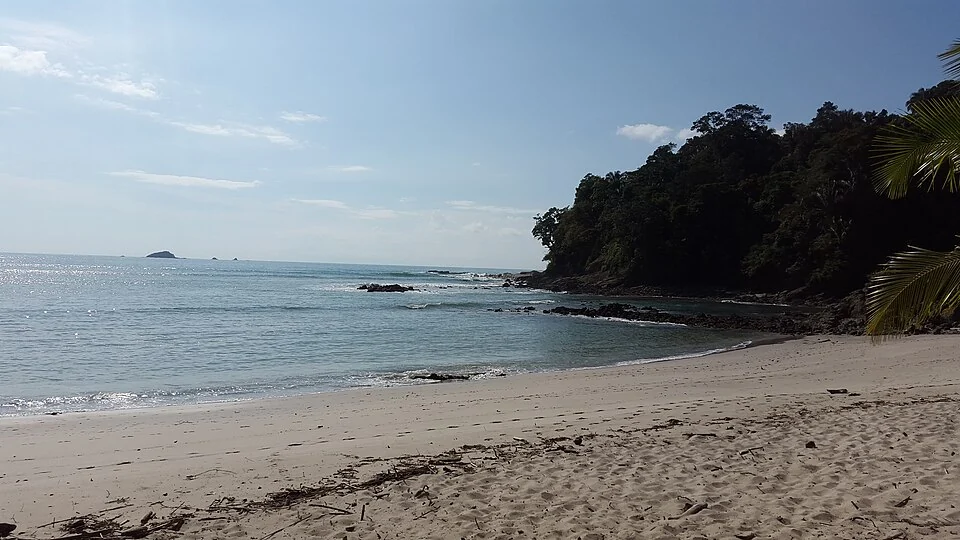
Beaches. SINAC names Playa Manuel Antonio, Playa Espadilla Sur and Playa Gemelas inside the park; the official map also labels Playa Puerto Escondido. Playa Espadilla Norte is outside the boundary — the brochure lists it as “FREE | GRATIS” and open every day 5:00 to 18:00. That is the answer for a Tuesday, or for any arrival after 3 p.m. The park-road lodging band runs about US$55 to US$700 a night and Quepos about US$20 to US$197, priced for 10–12 November 2026, on our where to stay in Manuel Antonio page.
Punta Catedral is a tombolo, not a headland. SINAC’s page describes it as formerly an island that joined the coast through accumulated sediment forming a sand bar — “una faja arenosa llamada Tómbolo” — and it carries five lookout points over islands used by marine birds.
Trails. The official public-use map names El Perezoso, Punta Catedral, Los Congos, Las Gemelas, Puerto Escondido, Miradores, Mirador a Punta Serrucho and Catarata Estacional. El Perezoso is flagged as the accessible trail. SINAC’s 2017 press release warns that some trails are of “dificultad media y alta, por la topografía del terreno y cantidad de gradas” — medium and high difficulty, from the terrain and the number of steps. Trail lengths are not published on either document.
The park was created in 1972 under Ley No. 5100, originally as the Parque Recreativo Nacional Playas de Manuel Antonio, and was administered by the Ministry of Agriculture before transferring to SINAC.
Rules that are enforced at the gate
Bags are searched at the entry booth, and SINAC’s 2017 press release notes the check “genera largas filas de espera” — it generates long queues at busy times.
Prohibited: drones, single-use plastic food packaging, pets, alcohol, tobacco and cigarettes, firearms, sound equipment, sport and shore fishing, beach games including football, volleyball and frisbee, smoking and bonfires.
Allowed food, per the same press release: liquids other than alcohol, peeled fruit packed for individual consumption, individually packed sandwiches, and special diets for children, the elderly, pregnant women and those with specific dietary needs. There is a coffee shop and a souvenir store inside.
Two more from the brochure, both concrete rather than generic. Hire guides only from inside the gate: “avoid getting a tour guide from outside the park’s gate” — the Spanish text is blunter, “No confíe en extraños que le aborden en las afueras.” And there is no visitor parking at the entrance: “There is no parking for tourists. You will find private parking lots in the premises.” The brochure advises checking whether a private lot charges by the hour or by the day before you leave the car, and leaving nothing visible inside it. Quepos is also one of the three districts Costa Rica’s Ministry of Justice records with the most homicides in 2025 — what that band does and does not mean for a visitor is set out separately.
Getting there, at the officially regulated fare
Costa Rica regulates intercity bus fares, and ARESEP publishes the whole national register as open data. We pulled it on 26 August 2026.
| Journey | Regular fare | Senior fare | Route |
|---|---|---|---|
| San José → Quepos | CRC 4,450.00 | CRC 3,340.00 | 613, TRACOPA |
| San José → Playas de Manuel Antonio | CRC 5,770.00 | CRC 4,330.00 | 613, TRACOPA |
| Quepos → Playas de Manuel Antonio | CRC 390.00 | CRC 0.00 — free | 653, Transportes Herosuma FD |
All three take effect 1 July 2026 under resolution RE067IT26/RE050IT26, dated 18 June 2026 and gazetted in La Gaceta 113 on 19 June 2026. We checked the register for any superseding row on these routes and there is none. Both San José fares match TRACOPA’s own published fare table to the colón, so the regulator and the operator agree independently.
The register also records the Quepos–Manuel Antonio route length as 7.02 km. That is what puts the leg under ARESEP’s 25 km threshold, which is why its senior fare is recorded as 0.00 — free — rather than as a percentage of the regular fare.
The next two comparisons are our arithmetic on the three regulated fares above; ARESEP publishes the fares, not the totals. Riding through to the beaches rather than stopping in Quepos costs CRC 1,320 more (CRC 5,770 against CRC 4,450). Getting off at Quepos and taking the local bus instead comes to CRC 4,840 in total (CRC 4,450 plus CRC 390) — about CRC 930 less than the through fare, at the cost of one transfer. TRACOPA’s table also lists two further San José–Quepos fares at CRC 5,380.00 and CRC 7,350.00, both on services it names “San José-Zona Sur Costanera” — one service name, not two — and it publishes no journey times against either, so “the bus to Quepos” is not one price.
The terminal and timetable, from the ICT/SINAC brochure: Terminal Transportes Tracopa, Calle 5, Av. 18/20, San José. Departures Monday to Sunday at 06:00, 08:45, 09:00, 10:30, 12:00, 13:15, 14:30, 16:00, 16:45 and 19:30; returns at 04:00, 06:00, 07:30, 09:30, 12:00, 13:00, 14:30 and 17:00. Phone (506) 2221 4214 and (506) 2777 0263. The brochure gives the journey as 3 hours; the aggregator BuscoBus gives 4 hours, names a different operator — Transportes Delio Morales — and carries a fare about 1% below the regulated one, across 13 departures. The fare and the operator are settled by ARESEP’s concession register: TRACOPA, CRC 4,450. The journey time is not: 3 hours and 4 hours both stand, and ARESEP regulates fares, not timetables. Which shuttle and bus departures still reach the park before it closes is worked through on our San José to Manuel Antonio page.
SINAC recommends public transport over driving in peak weeks, and warns of wildlife crossing the road. Public transport from Quepos reaches the public beach in the village of Manuel Antonio, which is outside the park boundary.
What the operators don’t publish
These are gaps in the published record, not in our search:
- The park’s area in hectares. SINAC’s park page does not state it and the brochure map did not carry it in extractable text. A hectare figure surfaced in a search summary of sinac.go.cr but was never confirmed on a page we actually fetched, so we do not print it.
- Trail lengths. The trail names are published; the distances are not.
- Wildlife species counts. SINAC publishes these for Arenal (79 mammals, 56 amphibians) and not for Manuel Antonio in anything we fetched.
- Any current daily visitor cap. SINAC’s live park page and the SICORE portal publish none; the undated tariff PDF’s 1,600 is superseded by a litigated sequence ending at the 2,501 announced in May 2024.
- Sansa fares from San José to Quepos (XQP). flysansa.com publishes no fares outside its booking engine. Aggregators quote a one-way fare band that we could not verify at the airline, so we do not reproduce the figures.
How we researched this
Scope: this page reports source research, not an on-site test. We checked the booking systems, timetables and official sources named below on the date shown; calculations, unresolved disagreements and information we could not verify are labelled explicitly.
On 26 August 2026 we read SINAC’s Spanish and English pages for Parque Nacional Manuel Antonio, the ICT/SINAC visitor brochure (Version 2023), SINAC’s press release of 07.04.2017, SINAC’s consolidated entrance-tariff PDF and its national online-reservation list. Fees, hours, the Tuesday closure and the online-only rule come from the park pages; park rules, trail names, the free Espadilla Norte hours, the parking warning and the San José bus timetable come from the brochure; the queue and food-allowance details come from the press release.
Bus fares come from a direct pull of ARESEP’s open-data fare register — the regulator’s own file, not a schedule site — cross-checked against TRACOPA’s own published table. The 7.02 km route length is ARESEP’s recorded figure.
Where SINAC’s own documents disagree with each other, we print both and say which one is maintained. The one figure we do resolve is USD 16 against USD 18.08, because SINAC states the tax convention itself and the arithmetic closes exactly.
We deliberately did not carry forward the USD 16 non-resident fare quoted in SINAC’s 2017 press release. That document sold tickets through Coopealianza and predates the online-only system; it is price history, not a current rate.
Figures on this page labelled our arithmetic are calculated by us from the sourced inputs cited below — comparisons, percentages, multiples, differences, per-night and per-person conversions, running totals and currency conversions. Every other figure is reproduced as its named source published it. Where an operator or authority publishes a per-person or per-night rate directly, that is their figure and it is attributed to them at the point it appears.
Sources
SINAC — Parque Nacional Manuel Antonio (Spanish) — the USD 18.08 and USD 5.65 fees, Wednesday–Monday 7:00 a.m.–3:00 p.m. with Tuesday closed, online-only sales, the beaches, the tombolo, the 1972 creation under Ley 5100.
SINAC — Manuel Antonio National Park (English) — the “$16 + IVA” and “$5 + IVA” wording, the single-use ticket and the ID requirement, and an independent repeat of the 3 p.m. close.
SINAC / ICT — Parque Nacional Manuel Antonio visitor brochure, Version 2023 — trail names and the accessible-trail flag, the prohibited list, the free Playa Espadilla Norte hours, the no-parking statement, the guide warning, the Tracopa terminal address and timetable, and the competing 16:00 closing time.
SINAC — press release, 07.04.2017 — the bag-check queues, the allowed-food list, the trail-difficulty warning, the cédula rule, and the Quepos-to-village public transport structure.
SINAC — Tarifas de ingreso a áreas silvestres protegidas (PDF, no date on its face; file metadata dated 21 December 2018) — the superseded 1,600-a-day capacity figure, the competing 4 p.m. close and the competing seasonal Monday closure. We read the file’s own metadata on 26 August 2026: creation and modification dates are both 21 December 2018.
SINAC — Compra y Reserva en Línea — the list of 12 reservation-required parks, and Arenal’s absence from it.
SINAC — Sistema de Compra y Reservaciones en Línea (SICORE) — the ticket portal itself, and FAQ item 1’s competing list of 11 areas sold through it.
Delfino.cr — Gobierno aumenta a 2.500 personas el aforo diario del Parque Manuel Antonio — the 2,501-a-day figure announced by MINAE on 29 May 2024, cited here only to show that the 2018 PDF’s 1,600 has been superseded.
ARESEP — Pliego tarifario de autobús, open-data register — CRC 4,450.00, CRC 5,770.00 and CRC 390.00, the senior fares including the 0.00 recorded on route 653, the concessionaires, the resolution and effective date, and the 7.02 km route length.
TRACOPA — Tarifas — the operator’s own fare table, matching ARESEP, plus the two “San José-Zona Sur Costanera” San José–Quepos rows. Re-read at source on 26 August 2026.
BuscoBus — San José to Quepos — the competing operator name, its slightly lower fare, 13 departures and 4-hour duration, cited here only as the claim that ARESEP contradicts.
ARESEP - Tarifas de autobus (the regulator’s own bus-tariff page) — ARESEP’s OWN STATED senior-fare rule, in its own words - including the over-65 threshold the site had been asserting unsourced, and the 0 / 50 / 75 per cent bands. Read 2026-08-27.
Last verified: 2026-08-26, except ARESEP’s own senior-fare rule and the over-65 threshold, read at the regulator on 2026-08-27. Park fees, opening hours and regulated bus fares change; the bus fares above are current from 1 July 2026 until the next ARESEP resolution.
Written by Estuardo Enriquez. This site is independent, carries no affiliate relationship with any operator named here, and is not connected to any previous owner of this domain.