Is Costa Rica Safe? The Advisory Level, and the Official Crime Data by Area
Verified on 26 August 2026, by loading the live U.S. State Department advisory page in a real browser and reading Costa Rica’s own Ministry of Justice homicide report for 2025.
The U.S. Department of State rates Costa Rica Level 2 — Exercise increased caution. The page prints “Date issued: April 02, 2026”, and the single risk indicator attached is CRIME (C) — no terrorism, civil unrest, health, kidnapping, natural-disaster or wrongful-detention indicator is applied. Costa Rica has zero Do Not Travel and zero Reconsider Travel zones, and the page carries no “Some areas have increased risk” carve-out.
The two official records point in different directions about what actually reaches a visitor. The advisory leads with theft; Costa Rica’s own homicide data shows the lethal violence is overwhelmingly settled between criminal parties. Both statements are quoted below. Two related rules sit on other pages rather than this one: the national child-restraint decree and the tour operators’ own minimum ages are on our Costa Rica with kids page, and whether to drive yourself at all is weighed in our rental car versus shuttle comparison.
The advisory, verbatim
Exercise increased caution in Costa Rica due to crime.
Advisory summary: Petty crime is common throughout Costa Rica. Violent crime also affects tourists. This includes armed robbery, homicide, and sexual assault.
The four levels the same page lists are: Exercise normal precautions / Exercise increased caution / Reconsider travel / Do not travel. Costa Rica sits on the second.
One date discrepancy, printed both ways — and it has an explanation. The advisory page itself prints April 02, 2026. The State Department’s own machine-readable feed at cadataapi.state.gov timestamps the same advisory 2026-04-01T20:00:00-04:00. That is 8pm Eastern on 1 April, which is midnight UTC on 2 April: the same instant expressed in two time zones, a feed-publication artefact rather than a second issue date. We quote the date the advisory page prints, record the feed’s timestamp beside it, and do not write “early April”.
Where the official data says the risk actually is
Costa Rica’s Observatorio de la Violencia (Ministerio de Justicia y Paz), working from Organismo de Investigación Judicial records, bands every district by homicide incidence rate — a per-capita rate, not a count.
Districts rated HIGH or VERY HIGH in 2025:
Bahía Ballena, Cabo Velas, Carmen, Carrandi, Chacarita, Limón, Matama, Merced, Nosara, Parrita, Quepos, Río Blanco, Samara, Tamarindo, Tempate and Toro Amarillo.
Several of those are places visitors stay. Carmen and Merced are downtown San José; Cabo Velas and Tempate cover Playa Flamingo, Brasilito and the Tamarindo hinterland.
Read the counts next to the rates before drawing any conclusion. Within that same high band, the report names the three districts with the most homicides: central Limón with 63, Chacarita (Puntarenas) with 21, and Quepos with 19. Because the banding is per capita, small-population beach districts such as Nosara, Sámara, Tamarindo, Cabo Velas and Tempate can reach the top band on a handful of cases. Saying “Tamarindo is in Costa Rica’s highest homicide band” is literally true and incomplete without that sentence.
Districts rated MEDIUM include more places visitors stay: Jacó, Cobano (Santa Teresa and Malpaís), Puntarenas, Barranca, Matina, Siquirres, Guácimo, La Cruz, Nacascolo (Papagayo), Cañas Dulces, Cartagena and Puerto Carrillo, alongside the San José districts of Pavas, Hatillo, Hospital, San Sebastián, Alajuelita and Tirrases. The three largest counts in that band are Pavas 39, Hatillo 34 and San Felipe 23 — all San José metropolitan districts, none of them tourist areas.
At province level the report publishes a ranking only: in 2025 homicides continued to concentrate in San José, Puntarenas and Limón. It publishes no annual provincial counts, so none are quoted here — the single-day provincial split for 18 October further down is the one place it breaks a figure out by province.
The national numbers, and who they happen to
| Measure | 2025 |
|---|---|
| Intentional homicides (homicidios dolosos) | 872 — a decrease of 0.5% on 2024 |
| Six-year total, 2020–2025 | 4,471 victims |
| Male victims | 90% (787 people) |
| Female victims | 10% (85 people) |
| Victims aged 12 to 35 | 60% |
| Days of the year recording at least one homicide | 89% |
The six-year trajectory: +3% from 2020 to 2021, +12% in 2022, a 37% jump in 2023, −3% between 2023 and 2024, and, in the report’s own words, constant since 2024. “Constant” is the report’s characterisation of its own 2025 figure, which is the −0.5% in the table above.
The dominant motive is ajuste de cuentas — score-settling between criminal parties. It is the leading motive for victims of both sexes, with discusión / riña second. Among collateral victims specifically, score-settling accounts for 82% of cases and argument-or-brawl only 9%.
Set that against what the advisory itself emphasises. Its summary opens with “Petty crime is common throughout Costa Rica” before naming violent crime, and its Crime section opens “Petty theft and pickpocketing are common crimes for U.S. travelers.” But the same advisory states plainly that “Violent crime also affects tourists. This includes armed robbery, homicide, and sexual assault.” So the two things it tells you are not in tension and we are not resolving them: petty theft is what it calls common for travellers, and it says violent crime reaches tourists too. The homicide data below is national and carries no visitor breakdown, so it cannot tell you which of those you are more likely to meet.
One arithmetic note the report leaves open. The report states an average of 2.68 homicide victims a day. Its own annual total of 872 across 365 days is 2.39 a day. The report also states that 11% of days recorded no homicide; 872 divided by the 325 days that did record one — the remaining 89% of 365 — is 2.68. So the 2.68 is reproducible — it is the per-active-day rate, not the per-calendar-day rate. What the report does not do is say so. We print both figures and label which denominator produces each.
By weekday, the 2025 victims fall: Sunday 161, Saturday 139, Wednesday 122, Monday 119, Tuesday 116, Thursday 111, Friday 104. Those seven values sum to exactly 872, and the four days the report names as its highest — Saturday, Sunday, Wednesday, Monday — total 541, which is 62.04% of the 872 annual total — not of the year — and matches the report’s own “62% of cases” statement. The worst single day was 18 October, with 10 homicides: 7 in San José province, 2 in Limón and 1 in Alajuela.
The hazard the advisory names as a repeat killer of visitors is not crime
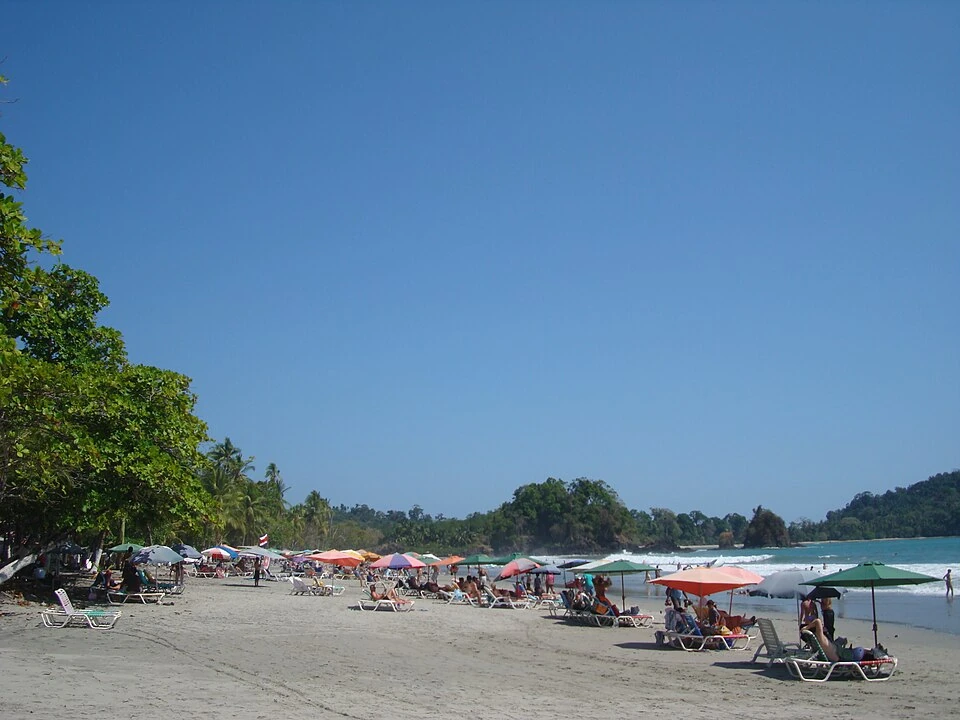
Rip currents in Costa Rica are very dangerous. They are responsible for numerous drownings of U.S. tourists every year.
The embassy tips block on the same page puts it more bluntly: “Rip tides kill dozens of U.S. citizens every year in Costa Rica.” Both sentences stop at “dozens” and the page publishes no count anywhere, so we quote the word rather than turn it into a figure.
The directly connected fact, also verbatim from the advisory: “Most beaches do not have lifeguards or warnings about unsafe conditions.” The State Department publishes the list of beaches that do have lifeguard presence, with its own caveat attached:
Costa Rican authorities have lifeguard presence at the following locations. However, stations may or may not be staffed, may be far apart, poorly equipped, or have limited visibility.
| Coast | Beaches with lifeguard presence |
|---|---|
| Pacific | Manuel Antonio, Caldera, Esterillos Oeste, Bahía Ballena, Ventanas, Tamarindo |
| Caribbean | Cocles, Manzanillo, Negra (Limón), Punta Uva |
Ten beaches, on a country with two coastlines.
Theft, as the embassy describes it
Three specifics the advisory names, quoted rather than summarised:
- “Armed robbers often target smartphones, wallets, or purses. If someone with a weapon confronts you, do not resist.”
- “Even a locked car in a parking area can be a target. Always check that car doors are locked, as thieves can block key fob signals with electronic jammers.”
- “People have reported robberies, including armed robberies, at short-term rental properties. Ensure your rental has good security and lock all doors and windows.”
One structural fact worth knowing: “The Costa Rican Investigative Police (OIJ) is responsible for investigating and prosecuting crime. But they will only act if the victim files a police report (denuncia).” The advisory adds that a report with a case number is what insurers and airlines ask for.
Where Tourist Police can give limited assistance to start that process, per the advisory’s own list: the San José city office at Central Park, the airports, and Puerto Viejo, Cahuita, Tamarindo, Brasilito, Flamingo, Nosara, Santa Teresa, Dominical and El Coco beaches. The report itself is filed with the OIJ.
Two non-crime hazards the advisory flags by name
- “Costa Rica is in an active earthquake and volcanic zone.”
- “Marijuana and marijuana-related products are illegal in Costa Rica.”
Numbers to have
- 911 — police, fire and ambulance in Costa Rica. Dialling it needs a working line: what a local prepaid SIM or a travel eSIM costs is priced separately.
- +506-2519-2000 — U.S. Embassy San José, Calle 98, Vía 104, Pavas. After-hours emergency +506-2220-3127. Email
[email protected].
Costa Rica publishes its own crime statistics, and you can query them
The OIJ runs a public Estadísticas Policiales portal that returns counts by date range and by province, cantón and district across Asalto, Hurto, Robo, Tacha de Vehículo, Robo de Vehículo and Homicidio, with XLS, CSV, HTML and ODS export, published under a Creative Commons BY 4.0 open-data licence. That is the primary source for area-level property crime. The portal reports counts for the whole population; it does not break them out by visitor or resident, so it cannot tell you a tourist-specific rate.
What the agencies don’t publish
These are gaps in the official record, not conclusions we reached:
- Per-province homicide counts for 2025. The Observatorio document gives the provincial ranking but not the counts. Province-level numbers circulate in the press attributed to the OIJ; none was verified at a primary source, so none appears here.
- A homicide rate per 100,000. The Observatorio document omits it, and computing one would require a population figure from a source we did not pull. Left out rather than derived.
- Theft and assault counts broken out by tourist district. The OIJ portal can produce these by query, but its data endpoint is script-loaded and the script did not download; only the portal’s filters and categories could be read.
- Any figure for crimes committed against foreign visitors specifically. Both the OIJ portal front page and the Observatorio report omit any breakdown of victims by nationality.
- A count of annual rip-current drownings. The State Department writes “numerous” and “dozens” and publishes no number.
- The OSAC Country Security Report for Costa Rica. The advisory links to it by name, but
osac.govreturned HTTP 404 on the report path tried on 26 August 2026.
How we researched this
Scope: this page reports source research, not an on-site test. We checked the booking systems, timetables and official sources named below on the date shown; calculations, unresolved disagreements and information we could not verify are labelled explicitly.
The advisory level, issue date, risk indicator, summary wording, beach and Tourist Police lists, theft descriptions, embassy tips and contact numbers were read from the live State Department advisory page loaded in a real browser on 26 August 2026, after clearing a Cloudflare challenge that blocks plain fetches. The advisory has a new canonical URL; the older /content/travel/en/traveladvisories/ path now redirects to it, and the new one is what is linked below. The one-day date discrepancy was found by comparing that page against the State Department’s own JSON feed.
Every homicide figure — the 872 total, the six-year trajectory, the sex and age split, the motive shares, the district bands and their counts, the weekday distribution — was read from the Observatorio de la Violencia’s Análisis de Homicidios Dolosos, 2025, which states it was built from administrative records supplied directly by the OIJ.
The weekday values are data labels on the report’s Gráfico 5 with no axis labels in the text layer, so the day order was established rather than assumed: the seven values sum to the report’s own annual total of 872, and under a Monday-first reading the four days the report names as highest come to 62.04%, matching its own “62%” statement. A Sunday-first reading gives 58.1% and contradicts the report, so it is ruled out. Under the Monday-first reading — the one that matches — Sunday, not Saturday, is the single worst day.
Where a figure appeared only in press reporting and not in a primary document, it is not on this page.
Last verified: 26 August 2026. Advisory levels change without notice; check the level and issue date at the source before relying on this page.
Figures on this page labelled our arithmetic are calculated by us from the sourced inputs cited below — comparisons, percentages, multiples, differences, per-night and per-person conversions, running totals and currency conversions. Every other figure is reproduced as its named source published it. Where an operator or authority publishes a per-person or per-night rate directly, that is their figure and it is attributed to them at the point it appears.
Sources
- U.S. Department of State — Costa Rica Travel Advisory — the Level 2 rating, the “Date issued: April 02, 2026” line, the CRIME (C) indicator, the absence of any area carve-out, the advisory summary wording, the petty-theft framing, the rip-current sentences, the ten-beach lifeguard list and its caveat, the “most beaches do not have lifeguards” line, the Tourist Police locations, the denuncia requirement, the three theft descriptions, the earthquake/volcano and marijuana lines, and all emergency numbers.
- U.S. Department of State — Travel Advisories JSON feed — the 2026-04-01T20:00:00-04:00 timestamp recorded against the printed April 02 date.
- Observatorio de la Violencia, Ministerio de Justicia y Paz — Análisis de Homicidios Dolosos, 2025 — the 872 total and −0.5% change, the 4,471 six-year total and year-by-year trajectory, the 90/10 sex split and 60% aged 12–35, the score-settling motive and its 82%/9% collateral split, the high/very-high and medium district lists, the Limón 63 / Chacarita 21 / Quepos 19 and Pavas 39 / Hatillo 34 / San Felipe 23 counts, the provincial ranking, the 2.68 daily average, the 89% of days figure, the weekday values and the 18 October worst day.
- OIJ — Estadísticas Policiales portal, Poder Judicial de Costa Rica — the queryable crime categories, the province/cantón/district filters, the export formats and the CC BY 4.0 open-data licence.
Written by Estuardo Enriquez. This site is independent, has no relationship with any agency named here, and is not connected to any previous owner of this domain.