Costa Rica Currency, ATMs and Cards: What the Colón Actually Costs You
Verified on 26 August 2026, against the Banco Central de Costa Rica’s own indicator feeds and payment-system statistics workbooks, plus two Costa Rican banks’ published pages.
On 26 August 2026 the BCCR reference rate was 1 USD = 450.21 colones to buy and 453.50 to sell. On the same day DAVIbank, the former Scotiabank de Costa Rica, posted 441.00 / 459.00 on its own counter board. The colón floats — Costa Rica has run a managed-float regime since January 2015 — so both of those numbers were true for one day and are wrong now.
The pair of figures is the useful part. The gap between the statutory benchmark and what a bank counter actually offers is the cost of changing money, and Costa Rica’s own payment statistics point somewhere else entirely: cash withdrawals have fallen while card acceptance has grown to 211,676 terminals.
The rate, on one day, from two sources
| Source, 26 August 2026 | Buy (compra) | Sell (venta) | Spread | Spread as % of sell |
|---|---|---|---|---|
| BCCR reference rate | 450.21 | 453.50 | 3.29 | 0.73% |
| DAVIbank counter board | 441.00 | 459.00 | 18.00 | 3.92% |
These are not two claims about the same thing and they are not averaged. The BCCR reference rate is the statutory benchmark, labelled on the bank’s own site as “Tipo de cambio de referencia de compra/venta del BCCR.” A commercial bank’s board rate is what a customer is actually offered, and it is deliberately wider. Note also that the DAVIbank page carries no date stamp for its rate; we read it on 26 August 2026. Both columns describe the institution’s action, which is the convention the boards themselves use: compra is what it pays you for a dollar, venta is what it charges you for one. So the 441.00 column is the rate a visitor receives when converting dollars into colones, and the 459.00 column is what the same visitor pays to convert colones back.
Our arithmetic on those four numbers, checked in each direction rather than at one point:
- Turning dollars into colones at the bank counter — its compra side — pays 441.00 against the reference buy rate of 450.21: 2.05% less.
- Turning colones back into dollars — its venta side — costs 459.00 against the reference sell rate of 453.50: 1.21% more.
- A full round trip at the bank loses 3.92% of the amount; the same round trip at the reference rate would lose 0.73%.
Why it moves at all, in the Central Bank’s own words: “En Costa Rica, el régimen cambiario vigente desde enero de 2015 es el de flotación administrada… el tipo de cambio está determinado por las fuerzas de oferta y demanda, y el Banco Central sólo interviene para mitigar episodios de alta volatilidad, pero no busca influir en su tendencia.” Supply and demand set the rate; the Central Bank smooths volatility and does not steer the trend. That reference sell rate is the one every dollar conversion on this site is made at and dated to — the prepaid data prices on our SIM card and data page and the reserve tariffs on our Monteverde’s four reserves compared page among them.
What an ATM withdrawal costs a foreign card
| BAC Credomatic, published | Figure |
|---|---|
| Fee for other banks’ customers and international cards | USD 7.80 per withdrawal — “El banco emisor de la tarjeta cobra otra comisión adicional” |
| Maximum single withdrawal on a foreign card | Set by the card issuer, but not above USD 2,000 or its colón equivalent |
| Daily withdrawal cap at BAC ATMs in Costa Rica | ₡600,000 or USD 1,500 |
| What a local BAC customer pays | 8 free withdrawals a month on payroll accounts, 6 otherwise; ₡575 per withdrawal after that |
BAC publishes those middle two rows as separate limits, and the lower one binds: the USD 2,000 figure is the ceiling BAC allows a card issuer to set for one withdrawal, while ₡600,000 / USD 1,500 is the most BAC’s own machines will pay out to a card in a day. A single USD 2,000 withdrawal is therefore not available at a BAC ATM in Costa Rica whatever the issuer permits.
That last row is the contrast worth having. The same machine charges a Costa Rican customer ₡575 — about USD 1.27 at the BCCR sell rate above — and a foreign card USD 7.80, roughly six times as much, before the issuing bank adds its own charge. BAC’s page states it was last updated 11 December 2025.
Because the fee is flat, its percentage cost depends entirely on how much you take out. Our arithmetic on BAC’s own figures, at the 26 August 2026 BCCR sell rate and excluding whatever the issuing bank adds:
| Withdrawal | USD 7.80 as a share |
|---|---|
| USD 100 | 7.80% |
| USD 200 | 3.90% |
| USD 400 | 1.95% |
| ₡600,000 — BAC’s daily cap, about USD 1,323 | 0.59% |
Costa Rican ATMs dispense dollars as well as colones. DAVIbank’s network “le permite disponer de su dinero… ya sea para retiros en colones o dólares”, with a minimum of ₡2,000 or USD 20 and a maximum per transaction of ₡250,000 or USD 400. Its first 7 transactions a month are free; from the eighth the commission is up to USD 1.5 per transaction, with 8 free under its payroll programme.
For structural scale — and this one runs in the opposite direction, so read the label — Banco de Costa Rica’s published tariff regulation sets what its own cardholders pay elsewhere: USD 1.00 to USD 3.00 for a cash advance at another local issuer’s ATM, and 0.50% to 1.00% of the amount plus USD 4.00 to USD 6.00 at a foreign issuer’s ATM or counter. That is a Costa Rican card abroad, not a foreign card in Costa Rica. It is quoted only to show the shape of the charge; the document’s own header reads “B-30-04 Vigencia: 25/01/2000 · Versión 58 rige a partir del 5/4/2024”. One mismatch worth stating: the file BCR serves it from is named B-30-04_v57_Reglamento...pdf, so the filename says v57 while the document body says version 58. We quote the header, link the file BCR actually serves, and leave the discrepancy on the record rather than picking one.
The trend a visitor can plan around: cash is shrinking, cards are not
Costa Rica’s Central Bank publishes the payment-system counts, and they move in opposite directions.
| BCCR payment statistics | 2022 | 2023 | 2024 | 2025 |
|---|---|---|---|---|
| ATM terminals | 2,629 | 2,662 | 2,612 | 2,530 |
| POS card terminals | 194,216 | 198,193 | 201,780 | 211,676 |
| ATM transactions (millions) | 112.64 | 104.67 | 99.44 | 87.74 |
| — of which cash withdrawals (millions) | 109.48 | 101.67 | 93.30 | 81.05 |
| POS card operations (millions) | 737.61 | 934.73 | 1,139.53 | 1,403.18 |
| POS operations on foreign-issued cards (millions) | 42.8 | 61.8 | 67.7 | 80.79 |
Our arithmetic across those rows: ATM transactions fell 22% between 2022 and 2025, cash withdrawals specifically fell 26%, and card operations at point of sale rose 90% — nearly doubling — over the same four years. There are 2,530 cash machines against 211,676 card terminals, about 84 card terminals for every ATM.
BCCR labels 2024 and 2025 as preliminary and warns that a 2024 review revised the earlier years: “en el 2024 se revisó el historial de transacciones reportadas… por lo que las estadísticas anuales publicadas para años anteriores han sufrido modificaciones.”
Three more figures from the same workbooks:
- Foreign-issued cards were used at Costa Rican POS terminals 80,787,936 times in 2025, worth ₡2,301.99 thousand million. That is a measured count of foreign cards working in Costa Rica, not an impression, and it has grown every year since 2022.
- Foreign cards accounted for 14.0% of the total 2025 POS value — ₡2,301.99 of ₡16,461.52 thousand million, by our division.
- The average POS transaction in 2025 was ₡11,731.57, down from ₡17,068.97 in 2022. At the 26 August 2026 BCCR sell rate that 2025 average is roughly USD 26 — small enough to indicate cards are used for ordinary purchases, not just large ones.
Costa Rica had 11,227,254 payment cards in issue at the end of 2025 — 7,809,851 debit and 3,417,403 credit. BCCR’s own per-million ratios imply a population of about 5.19 million, which would put that at roughly two cards a head; that population figure is back-derived from BCCR’s ratios and is not separately sourced, so treat the per-capita framing as indicative only.
The notes and coins in circulation
| Denominations | |
|---|---|
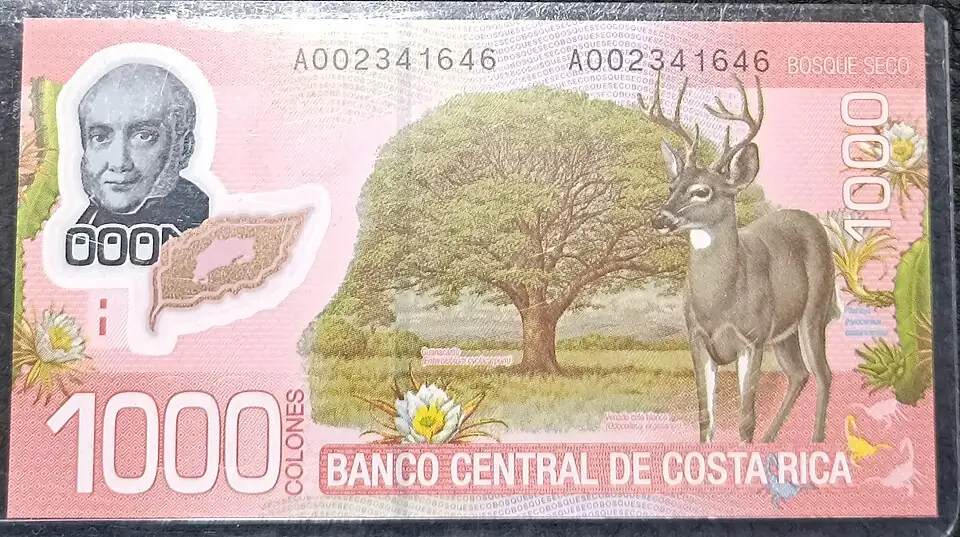
| Banknotes | ₡1,000 · ₡2,000 · ₡5,000 · ₡10,000 · ₡20,000 |
| Coins | ₡10 · ₡25 · ₡50 · ₡100 · ₡500 |
BCCR maintains separate published sections for damaged notes and for notes withdrawn from circulation, and a section for coins out of circulation.
Card acceptance is regulated, and the Central Bank polices it
Costa Rica’s Decreto Legislativo No. 9831, Comisiones Máximas del Sistema de Tarjetas, caps the commissions payment-service providers may charge on card transactions and “delega en el Banco Central de Costa Rica la responsabilidad de emitir la regulación del sistema de tarjetas de pago y vigilar su cumplimiento.” BCCR publishes a technical study behind each ordinary commission review — the most recent published is the Estudio Técnico 2025 — plus downloadable registries of every credit-card issuer, debit-card issuer, acquiring provider and card brand operating in the country.
What the banks and the Central Bank don’t publish
These are gaps in the published record, not conclusions we reached:
- Whether US dollar cash is accepted for payment in shops, restaurants and hotels, and at what informal rate. Primary sources publish none, so this page asserts it in neither direction. What is measurable is above: 211,676 card terminals, 80.8 million foreign-card transactions in 2025, ATMs that dispense both currencies, and a bank counter that costs about 3.9% round trip.
- A same-day rate from Banco Nacional or Banco Popular.
bncr.fi.crdid not resolve on 26 August 2026 — a DNS failure, not a block. Only BCCR and DAVIbank rates were captured. - A historical USD/CRC series. The BCCR homepage indicator endpoint returns only the latest observation; the full series sits behind a single-page application whose data API was not identified, and the legacy tables require a session.
- ATM surcharges against foreign cards at Banco Nacional and Banco Popular ATMs. Only BAC’s USD 7.80 was sourced.
- The numeric caps on acquiring and interchange commissions under Ley 9831. BCCR describes the regime and links its technical study, but states no percentages in the page itself.
- An independently sourced Costa Rican population figure. The per-capita framing above is back-derived from BCCR’s own per-million ratios.
How we researched this
Scope: this page reports source research, not an on-site test. We checked the booking systems, timetables and official sources named below on the date shown; calculations, unresolved disagreements and information we could not verify are labelled explicitly.
On 26 August 2026 we read the BCCR’s homepage economic-indicator feeds directly — the buy and sell reference rates arrive as JSON with the observation date attached, and both carry "fecha":"2026-08-26". The exchange-rate regime description, banknote and coin denominations, and the card-system regulation come from BCCR’s own pages. Every payment-system count — ATM and POS terminals, transaction volumes, foreign-card usage, average transaction size and cards in issue — was read from BCCR’s published statistics workbooks for ATMs, POS terminals and payment cards, each covering 2010 or 2009 to 2025.
The commercial figures come from the banks: BAC Credomatic’s own ATM help page for the foreign-card fee and the caps, DAVIbank’s ATM page for its counter board and network limits, and Banco de Costa Rica’s published tariff regulation for the cash-advance structure.
The percentages, the round-trip costs, the fee-as-a-share table, the 84-terminals-per-ATM ratio, the four-year change figures and the 14.0% foreign-card share are our own arithmetic on those published values, and are labelled where they appear. Every figure on this page keeps the reference rate and the bank rate separate, and neither is presented as “the” exchange rate.
Last verified: 26 August 2026. The rate quoted here is a single day’s value on a floating currency and will be wrong tomorrow — read it at the source before relying on it.
Figures on this page labelled our arithmetic are calculated by us from the sourced inputs cited below — comparisons, percentages, multiples, differences, per-night and per-person conversions, running totals and currency conversions. Every other figure is reproduced as its named source published it. Where an operator or authority publishes a per-person or per-night rate directly, that is their figure and it is attributed to them at the point it appears.
Sources
- BCCR — reference buy rate indicator feed — 450.21, dated 2026-08-26.
- BCCR — reference sell rate indicator feed — 453.50, dated 2026-08-26, and the basis for the spread and every conversion on this page.
- BCCR — régimen cambiario — the managed-float regime since January 2015 and the intervention policy.
- BCCR — billetes y monedas — the note and coin denominations in circulation.
- BCCR — tarjetas de pago — Decreto Legislativo 9831, the BCCR’s regulatory mandate, the Estudio Técnico 2025 and the issuer and acquirer registries.
- BCCR — Actividad en cajeros automáticos (ATMs), 2010–2025 — the ATM terminal counts, transaction volumes, cash-withdrawal series, the 487.30 per-million ratio and the preliminary-data warning.
- BCCR — Actividad en terminales en puntos de venta (POS), 2010–2025 — the POS terminal counts, total and foreign-card operation volumes and values, and the average transaction size.
- BCCR — Tarjetas de pago emitidas, 2009–2025 — the 11,227,254 cards in issue and the debit/credit split.
- BAC Credomatic Costa Rica — using BAC ATMs — the USD 7.80 foreign-card fee, the USD 2,000 issuer ceiling, the ₡600,000 / USD 1,500 daily cap, and the local ₡575 charge with its free-withdrawal allowances.
- DAVIbank (formerly Scotiabank de Costa Rica) — cajeros automáticos — the 441.00 / 459.00 counter board, dual-currency dispensing, the ₡2,000 / USD 20 minimum and ₡250,000 / USD 400 maximum, and the seven-free-transactions allowance.
- Banco de Costa Rica — Reglamento de Tarifas y Condiciones B-30-04 — the cash-advance commission ranges, quoted as a BCR card used elsewhere.
Written by Estuardo Enriquez. This site is independent, has no relationship with any bank named here, and is not connected to any previous owner of this domain.